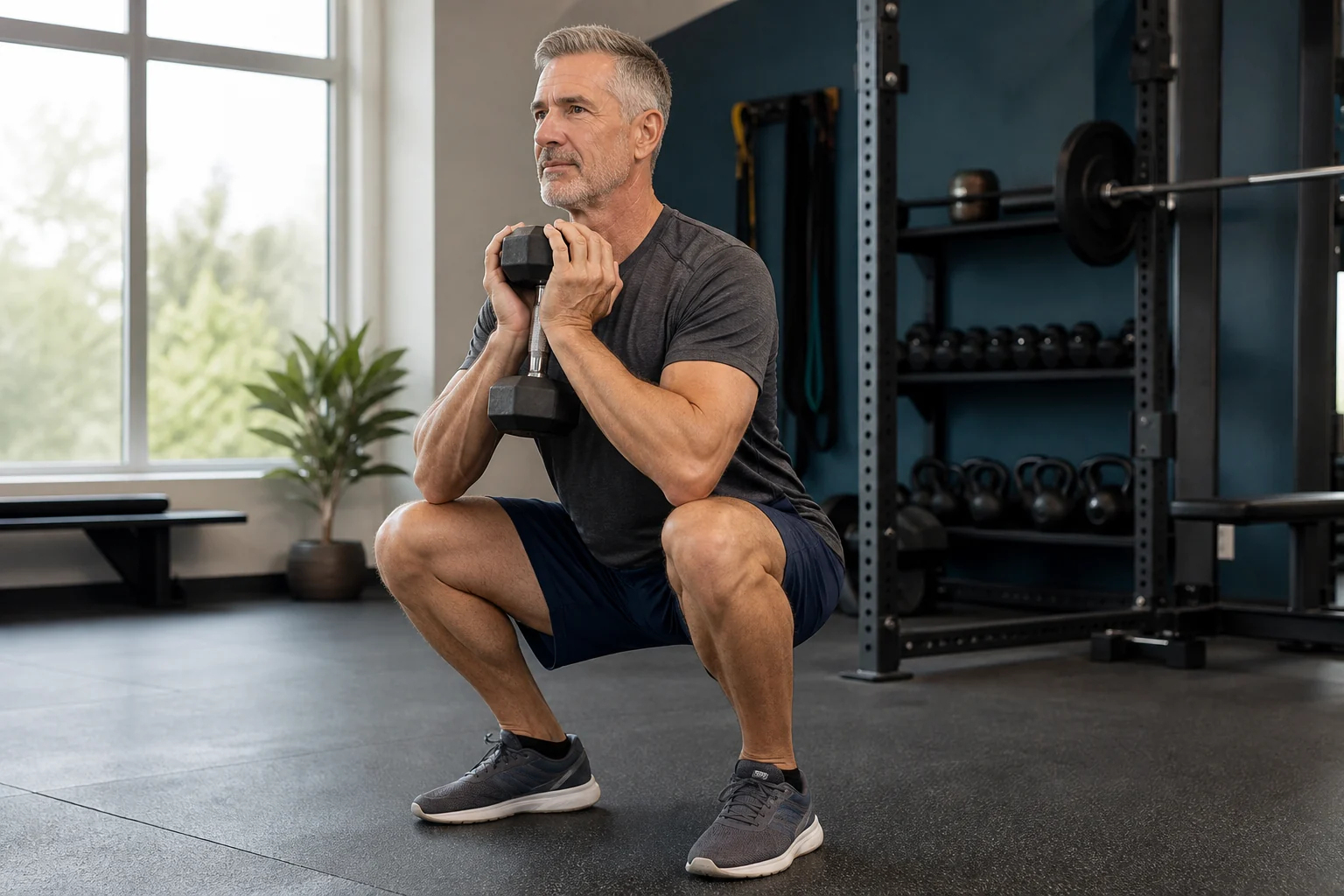
What should a two-day beginner plan include?
Train on two nonconsecutive days, such as Monday and Thursday. Each session should cover a knee-dominant movement, a hip-dominant movement, a push, a pull, and a carry or trunk exercise. Machines, dumbbells, bands, and bodyweight are all valid starting tools; choose whatever equipment you can control and progressively load.
| Movement | Day A | Day B | Starting dose |
|---|---|---|---|
| Knee-dominant | Goblet squat or leg press | Step-up or split squat | 1–2 sets of 6–12 |
| Hip-dominant | Dumbbell Romanian deadlift | Hip thrust or cable pull-through | 1–2 sets of 6–12 |
| Push | Machine or dumbbell press | Incline push-up or overhead press | 1–2 sets of 6–12 |
| Pull | Seated cable row | Lat pulldown or supported row | 1–2 sets of 8–12 |
| Carry or trunk | Farmer carry | Side plank or Pallof press | 1–2 controlled rounds |
The table is a starting framework, not a prescription for every person. Swap an exercise when equipment, mobility, pain, or medical guidance makes another pattern a better fit.
How hard should the first workouts feel?
Choose loads that let you finish each set with roughly two to four good repetitions still available. The final repetitions should require attention, but speed and technique should not collapse. This gives you room to learn the movements and observe soreness, joint response, sleep, and energy before adding more work.
There is no requirement to train to failure. The 2026 ACSM position stand found that many resistance-training formats improve strength and muscle outcomes, while equipment type and training to momentary fatigue do not consistently determine results [1].
How should weight and repetitions progress?
Keep the exercise, sets, and target repetition range stable long enough to compare sessions. When you reach the top of the range with controlled technique in two consecutive workouts, add the smallest available amount of resistance and return to the lower end of the range. If recovery worsens or symptoms appear, hold the load, reduce a set, or change the exercise instead of forcing the planned increase.
Progress can also mean a deeper pain-free range, steadier tempo, cleaner balance, or completing the same work with less effort. The log should tell you what changed; it should not pressure you to add weight every session.
How should lifting fit with cardio and recovery?
Adults are advised to combine muscle-strengthening work on at least two days with weekly aerobic activity [2]. You can place easy cardio after lifting or on the days between sessions. Hard intervals and demanding leg training may compete for recovery, so separate them when possible and adjust total work if performance drops across several sessions.
Normal post-training soreness is usually diffuse, improves as you move, and settles over a few days. Sharp pain, worsening joint pain, swelling, loss of function, or symptoms that change your movement deserve a different decision than routine soreness.
Which health issues change the starting plan?
Hypertension, heart disease, medications, diabetes, joint pain, previous surgery, and long periods without exercise can change exercise selection, breathing cues, rest periods, and progression. They do not automatically make resistance training inappropriate. The American Heart Association supports appropriately prescribed resistance exercise for many people with and without cardiovascular disease [3].
Avoid prolonged breath-holding when it has not been specifically cleared, and stop the session for chest pressure, fainting, severe or unusual shortness of breath, a racing or irregular heartbeat with symptoms, or sudden neurological symptoms. This guide cannot determine the cause or safety of an individual symptom.
When is professional guidance the better next step?
Get individualized medical or rehabilitation guidance before progressing when a condition is unstable, surgery is recent, symptoms are unexplained, or pain is severe or worsening. A qualified coach or physical therapist can also help when technique, balance, equipment setup, or confidence is the main barrier.
For everyone else, start with the beginner workout, frequency, load, and sets-and-reps guides below. Open only the pages that match your current situation, then turn those decisions into a two-day plan you can repeat.